


Almost everyone I know who gave up on Dream of the Red Chamber quit before Chapter 6.
That’s a shame, because Chapter 6 is just about where the novel turns into the book people fall in love with.
The first five chapters are the hardest stretch of the whole novel. Before the main characters have said much of anything, the book hands you a talking stone, a Buddhist monk, a Daoist priest, two dreams, a gossip session and a family tree. Plenty of smart readers decide right there that this book isn’t for them.
So how do you get through it? The short answer is that you don’t keep track of everybody. You follow three young people, you learn one house, and you let the rest wash over you until it starts to make sense on its own. It will.
Here’s how.
Why It Feels Like Too Much
Dream of the Red Chamber (紅樓夢) runs 120 chapters. In the Penguin edition that’s five fat volumes. It has hundreds of named characters, and a huge number of them share one surname, Jia (賈).
Then there are the names themselves. Most people in the novel go by more than one: a formal name, a pet name, a title, and whatever the servants call them. The same grandmother is “Grandmother Jia,” “the Old Lady” or “the Old Ancestor,” depending on who’s talking. Translators make it worse, because each English version handles the names differently. David Hawkes translates the maids’ names into English, so his Xiren is “Aroma.” The Yangs keep them in Chinese. Switch translations halfway through and you’ll think you’ve met a new character.
The first time I read this book I wasn’t sure I was even reading the right novel. It wasn’t until right around chapter 6 or 7 that the book started to resemble the book I thought I was going to wind up reading. It’s one of those books that only gets good when you really give it a chance.
None of that means the book is badly organized. It means it was written for readers who already knew how a big Qing family worked. You don’t, and that’s fine. You only need a few pieces to get started.
Follow Three People
The novel’s main thread is three teenagers living under one roof. Learn these three, and everybody else becomes the people around them.
Jia Baoyu (賈寶玉) is the family’s heir. He was born with a piece of jade in his mouth, which tells you right away that he isn’t an ordinary boy. His grandmother spoils him, his father despairs of him, and he’d much rather spend his time with his girl cousins and the maids than study for the civil service exams.
Lin Daiyu (林黛玉) is his cousin on his father’s side. Her mother has just died, so in Chapter 3 she comes to live with their grandmother. She’s brilliant, sickly, proud and quick to take offense, and she has the sharpest tongue in the house.
Xue Baochai (薛寶釵) is his cousin on his mother’s side. She arrives in Chapter 4 with her mother and brother. She’s calm, tactful and very well read, and nearly everyone in the house likes her.
If you’ve heard that this novel is a love story, these are the three people it’s about. That’s all I’ll say about that for now.
There’s a fourth person worth knowing early: Wang Xifeng (王熙鳳), the young wife who manages the household. She’s funny, ruthless and always the smartest person in the room, and she makes a grand entrance in Chapter 3. I wrote about her and the people who really run the house in Who Really Runs The House?
Learn One House
The Jia family lives in two mansions side by side on the same street: the Ningguo house (寧國府) and the Rongguo house (榮國府). They were built by two brothers, and both branches carry the Jia name. For now, all you need is this: most of the story takes place in the Rongguo house.
At the top of the Rongguo house is Grandmother Jia (賈母). Everything else hangs from her.
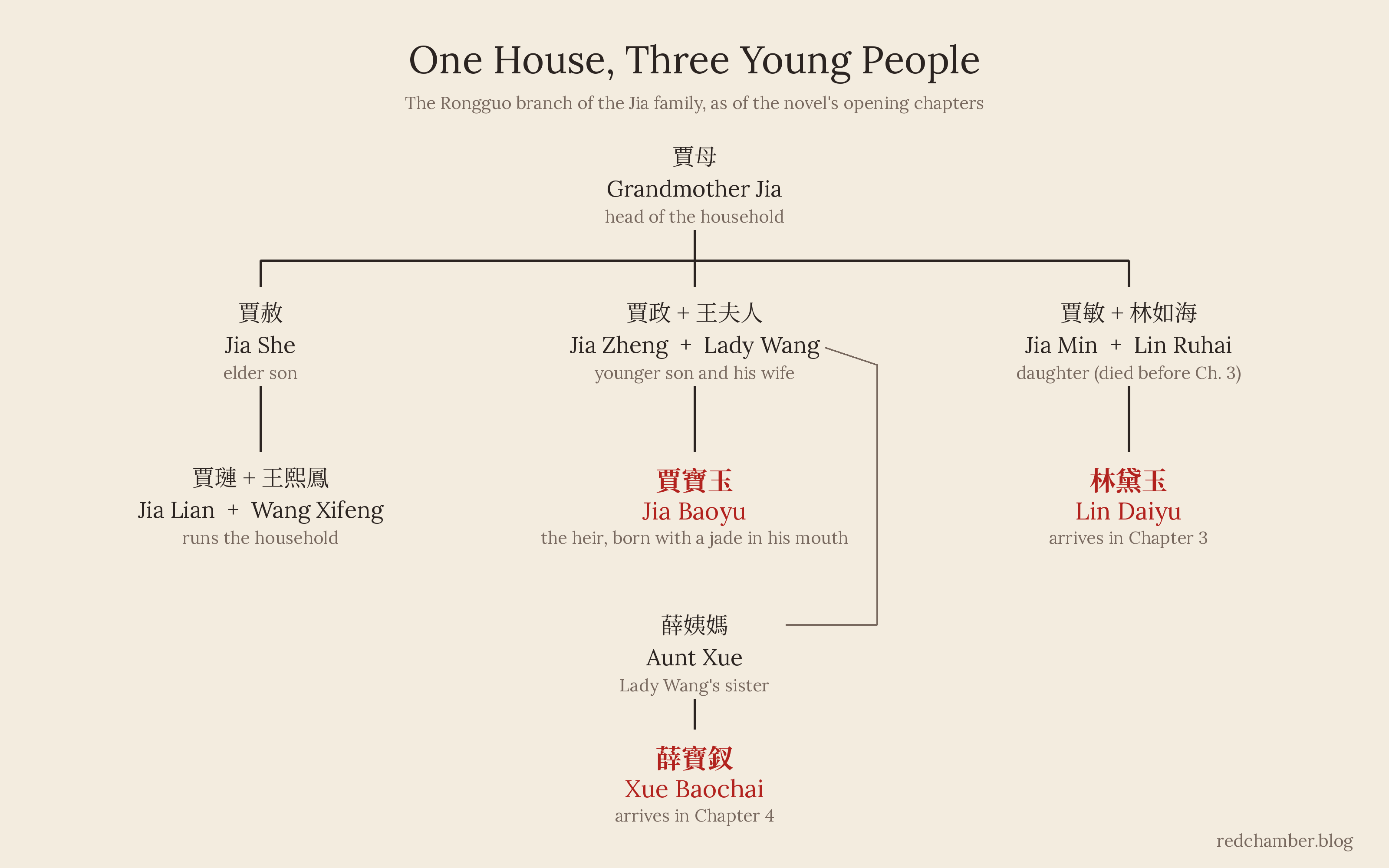
Look at where the three young people sit. Baoyu is the grandson in the middle. Daiyu comes from his grandmother’s side. Baochai comes from his mother’s side. Two cousins from opposite ends of the family, growing up in the same compound with the same boy. The novel doesn’t need to tell you there’s going to be tension. The family tree already does.
That’s most of what the family tree in Chapter 2 is trying to tell you, too. Remember the gossip session? We’ll get there in a second.
What to Skim and What to Slow Down For
You can’t read every page of this book at the same speed. Here’s where I’d let go and where I’d hang on.
Chapter 1: read it like a prologue. Before the family appears, the novel opens with a myth. To understand why, you have to know that this book wants you to question what’s real from the very first page. So it starts with a stone left over when the goddess Nüwa repaired the sky. The stone wants to see the human world, and a monk and a Daoist priest agree to take it there. You don’t need to understand every symbol. Read it the way you’d read the prologue of a fantasy novel: it sets the mood and tells you the story you’re about to read is half dream. Hang on to that stone, though.
Chapter 2: skim it. An antique dealer named Leng Zixing (冷子興) sits in a village wine shop and explains the whole Jia family to an old friend. It’s useful, but it comes before you’ve met a single one of these people, so it reads like a stranger’s guest list. Skim it, get the general shape, and move on. Once you’ve met Baoyu, Daiyu and Baochai, come back. You’ll be surprised how much of Leng Zixing’s gossip suddenly makes sense.
Chapter 3: slow down. This is where Daiyu walks into the Rongguo house and meets everyone, one person at a time. It’s the novel introducing its cast through the eyes of a girl who’s just as new as you are. Chapter 4 brings Baochai and her family to the capital, and then the cast is complete. Remember the stone from Chapter 1? Watch what Baoyu wears around his neck.
Chapter 5: don’t try to solve it. Baoyu falls asleep and dreams he’s in a fairy realm, where he reads a set of strange registers and hears a cycle of songs. They hint at the futures of the girls in the house, but they’re written as riddles. Baoyu can’t make sense of them either, and he wakes up none the wiser. Read it, enjoy how strange it is, and don’t stop to decode it. It’s one of the best parts of the novel to come back to later.
The names: don’t worry about them. Many names in the novel are puns. The first two men you meet are Zhen Shiyin (甄士隱), which sounds like “the true story hidden,” and Jia Yucun (賈雨村), which sounds like “false words remain.” Even the family name Jia (賈) sounds like the word for “false” (假). You don’t have to catch these yourself. That’s what notes are for. I go through the naming system in a full post on Dec 1.
Read It for the Small Scenes
Here’s the thing nobody tells you before you start: this isn’t a book you read for the plot. It’s a book about everyday life in a great house. Birthdays. A lost lock of hair. Cousins who quarrel and make up. Poetry contests. Maids who know everyone’s secrets before their masters do.
If you’ve watched Downton Abbey, you already know how to read this novel. There’s a big house, a family at the top, servants who see everything, and a quiet feeling that it can’t last forever. The difference is that Dream of the Red Chamber was written in the 1700s by someone who grew up in a family like this one, and it goes much deeper into the people.
So don’t race to find out what happens. Let a scene be a scene. That’s where the book lives.
Pick Your Way In
You’ve got a few choices.
If you’re reading in English and want to know which translation to buy, start with The English Translations, my rundown of every English version and where each one falls short.
If you’d like to read it one scene at a time, with notes on the names, jokes and allusions an English reader would miss, that’s what this blog is. I’m translating the novel into modern English from the 1792 edition, one passage at a time. You can start at the very beginning.
If you’re learning Chinese, every passage here comes with the original Chinese text and Reading Notes on the hard words. It’s a good way to take on the real thing without drowning.
And if you want a map while you read, the Characters page has free guides to the main characters. They never spoil what’s ahead.
So, How Do You Read It Without Getting Lost?
Stop trying to keep track of everyone. Follow Baoyu, Daiyu and Baochai. Learn the one house they live in. Skim the gossip in Chapter 2, don’t try to solve the dream in Chapter 5, and get yourself to Chapter 6.
Most people who quit this book quit because they tried to hold the whole thing in their heads at once. You don’t have to. Nobody did on their first read, in Chinese or in English.
If you’ve tried this book before and given up, tell me in the comments where you stopped. I’d love to know.
If you enjoyed this, there’s a lot more where it came from. Members read every passage of my translation as it comes out, with the Chinese text and notes, plus the weekly podcast and posts like this one. It’s $5 a month, and you’re helping fund a complete modern translation of China’s greatest novel.
New to the story? Chapter 1 starts here: The Dream Starts.
Start the story: The Dream Starts, or every Chapter 1 passage in order on the Chapter 1 page.
Next in the margins: On Thursday, why one of the oldest habits in Chinese literature looks a lot like fan fiction.
Meet them: Jia Baoyu / Lin Daiyu / Xue Baochai / All the characters