


Today’s video is about seven characters.
此開卷第一回也 is the first sentence of Dream of the Red Chamber. After a year and a half of Chinese, it was as far as I got. In the video I read it with you one character at a time, then keep going through the most important lines on page one.
I didn’t read all of it on camera. Twenty-five minutes only holds so much, and some of the Chinese I skipped is the most fun on the page. So watch the video first. When you’re done, the whole page is below, Chinese beside my English, with notes on the words the video left out.
You can watch it here:
What to Listen For
If you’re learning Chinese, three moments in the video are worth waiting for.
The first is 也. You learned it in your first month of Chinese, and in this sentence it doesn’t mean what your textbook says. That one comes in the first few minutes.
The second is the two men named in the chapter title. On the page they look like ordinary names. Say them out loud and they tell you exactly what the author is up to, and no English translation can make you hear it.
The third is the very last thing in the video: a line carved over a gate, seven characters long, just like the first sentence. By the time you get there, you’ll read it without my help. You’ll also find out where the word for “also” went, since 也 isn’t it.
The Whole Page
Here’s all of page one from the 1792 edition, broken into the pieces I translated. Try each piece in Chinese before you look at the English under it. The punctuation is mine. The 1792 printing has almost none, which the video shows you.
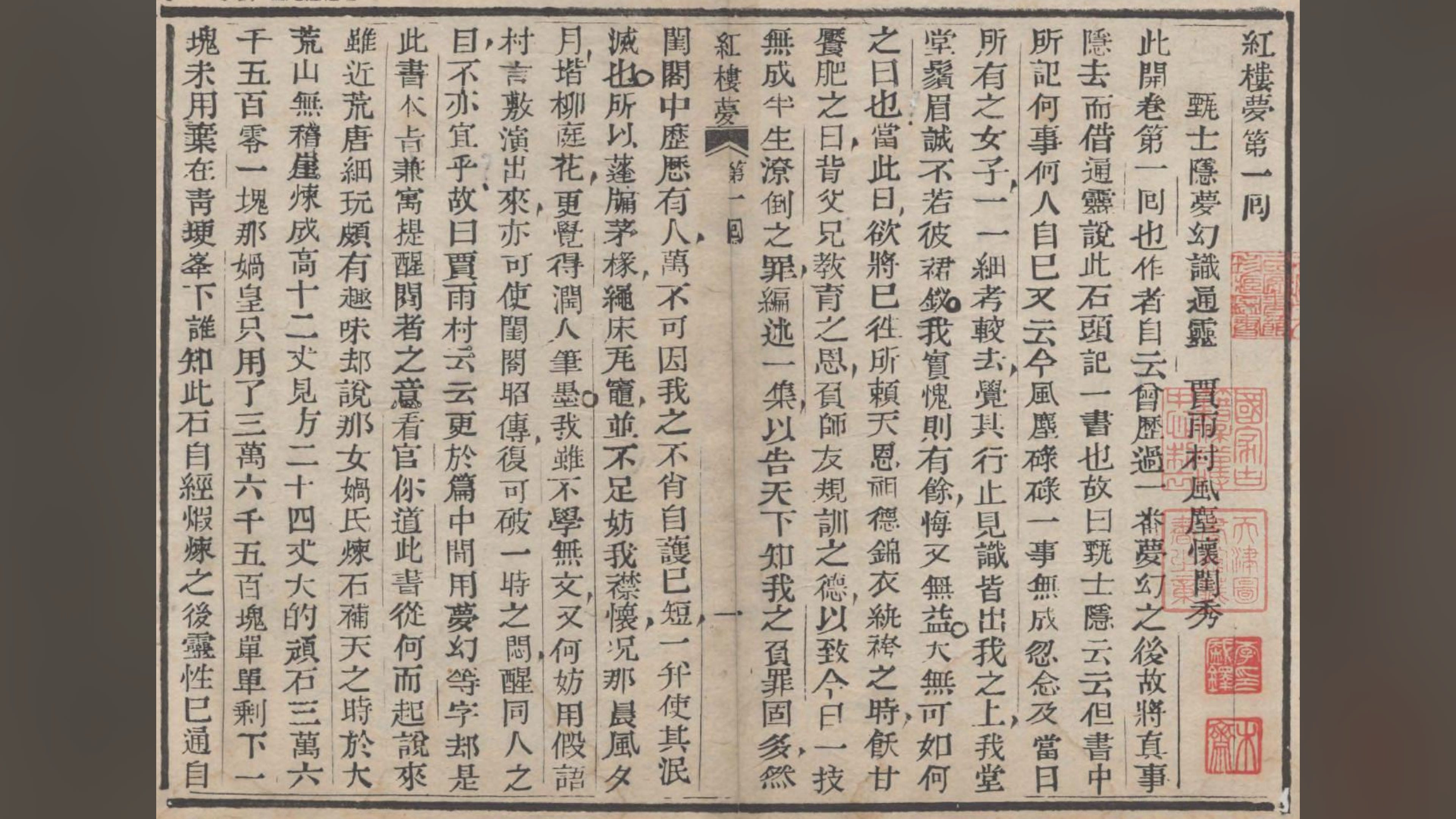
此開卷第一回也。
This is the first chapter of this book.
作者自云曾歷過一番夢幻之後,故將真事隱去,而借「通靈」說此《石頭記》一書也,故曰「甄士隱」云云。
The author says that, after having had a kind of dreamlike experience, he decided to hide the truth, relying instead on “spiritual communication” to write this book, The Story of the Stone. This is why he used names such as Zhen Shiyin.
但書中所記何事何人?自己又云:
But what about the events and characters in this book? Again, the author himself remarked:
「今風塵碌碌,一事無成,忽念及當日所有之女子,一一細考較去,覺其行止見識皆出我之上,我堂堂鬚眉,誠不若彼裙釵。我實愧則有餘,悔又無益,大無可如何之日也!
“Seeing that I’ve accomplished nothing in the midst of the hustle and bustle of this world, I started to think about the women I used to know. When I really thought about it, I realized that their actions and insights far surpassed my own. Though I am a grown man with a mustache and beard, I am truly no match for their skirts and hairpins. I feel deeply ashamed, but regrets help nothing. Alas, there’s nothing I can do about it now!
當此日,欲將已往所賴天恩祖德錦衣紈袴之時,飫甘饜肥之日,背父兄教育之恩,負師友規訓之德,以致今日一技無成,半生潦倒之罪,編述一集,以告天下。
“Right now I just want to remember those days, back when I enjoyed the blessings of heaven and the virtue of my ancestors, when I wore luxurious clothes and tasted delicious food. Those were the days when I disregarded the kindness of my father and elder brothers, who raised me, and neglected the admonitions of my teachers and friends. Those happy days all led to where I am today: no skills to speak of, and half a lifetime of poverty. I’ve written all of this down to confess my failings to the world.
知我之負罪固多,然閨閣中歷歷有人,萬不可因我之不肖自護己短,一併使其泯滅也。
“I know that I have many faults, and yet the memory of those girls remains strong. It would be awful to let their memories fade away completely just to hide my own shortcomings!
所以蓬牖茅椽,繩床瓦灶,並不足妨我襟懷。況那晨風夕月,階柳庭花,更覺得潤人筆墨。我雖不學無文,又何妨用假語村言敷演出來,亦可使閨閣昭傳,復可破一時之悶,醒同人之目,不亦宜乎?」
“And so even my simple hut and clay stove won’t discourage me. But that’s not all: the breeze in the morning, the moon in the evening, the willows on the steps, the flowers in the courtyard: all these things keep the ink in my brush flowing. Sure, I may be uneducated and poor at writing, but why can’t I use ordinary language to tell the story? Such language would illuminate the stories of those girls, dispel moments of boredom, and might even help others like me to wake up. Isn’t that appropriate?”
故曰「賈雨村」云云。
This is why he used names such as Jia Yucun.
更於篇中間用「夢」「幻」等字,卻是此書本旨,兼寓提醒閱者之意。
In the same vein, he often uses words like “dream” and “illusion” in this book. These words reflect the book’s main theme, and serve as a reminder to his readers.
Words the Video Skipped
The video spends its time on the first two sentences, the names and the last line. The author’s confession in the middle gets about a minute on camera, and that’s where the hardest Chinese on the page is. Most of it comes in four-character phrases, and the phrases come in pairs.
風塵碌碌,一事無成 (fēngchén lùlù, yí shì wú chéng). 風塵 is literally “wind and dust,” the grind of making your way in the world. 碌碌 is being busy and getting nowhere. 一事無成, “not one thing accomplished,” is still an everyday idiom, and plenty of people use it about themselves.
錦衣紈袴之時,飫甘饜肥之日 (jǐnyī wánkù zhī shí, yù gān yàn féi zhī rì). Brocade robes and fine silk trousers; stuffed with sweets and sated with rich food. 時 and 日 both mean “time” here, so the two halves line up word for word. If 紈袴 looks familiar, it’s because 紈袴子弟 (纨绔子弟 in simplified) is still what you call a spoiled rich kid.
背父兄教育之恩,負師友規訓之德 (bèi fùxiōng jiàoyù zhī ēn, fù shīyǒu guīxùn zhī dé). The same build twice: a verb, the people, what they gave him, then 之恩 or 之德. 背 is “turn your back on,” and 負 is “let down.” My English uses “disregarded” and “neglected,” because copying the pattern exactly gets clumsy in English.
不肖 (búxiào). 肖 means “to resemble,” as in 肖像 (a portrait) and 生肖 (your zodiac animal). 不肖 started out as a son who doesn’t take after his father, and came to mean “unworthy.” It’s the right word for a man who just told you he ignored his father.
泯滅 (mǐnmiè). To vanish without a trace. It’s the one thing he won’t let happen to the women he remembers.
蓬牖茅椽,繩床瓦灶 (péng yǒu máo chuán, shéng chuáng wǎ zào). Four objects: a window of woven brambles, rafters of thatch, a rope bed and a clay stove. In Chinese that’s a whole picture of poverty in eight characters. In English, four nouns in a row read like a shopping list, so my translation keeps two of them: “my simple hut and clay stove.”
晨風夕月,階柳庭花 (chén fēng xī yuè, jiē liǔ tíng huā). The breeze in the morning, the moon in the evening, the willows on the steps, the flowers in the courtyard. This time I kept all four, because each pair is built the same way. 晨 and 夕 are morning and evening; 階 and 庭 are the steps and the courtyard. The phrase right after it, 潤人筆墨, is literally “moistens one’s brush and ink,” which is where “keep the ink in my brush flowing” comes from.
The line over the gate at the end of the video is built the same way: two halves that mirror each other word for word. If you came straight to the notes, that’s your reason to go back and watch the ending.
Try One Yourself
My English drops two of the four objects in 蓬牖茅椽,繩床瓦灶. How would you translate all four without it sounding like a shopping list? Put your version in the comments.
Where to Go Next
If you want the same page with the full Reading Notes (堂堂鬚眉, 閨閣, 不亦宜乎 and the rest), it’s the first post of my translation: The Dream Starts. Chapter 1 keeps going on the Chapter 1 page.
If you’ve never read the novel and want to know who to follow, start with How to Read Dream of the Red Chamber Without Getting Lost.
Every passage on this blog works the way this page does: the Chinese, my English and notes on the hard words. Subscribe for free and the free passages come straight to your inbox. Members read every passage of the translation as it comes out, plus the weekly podcast, for $5 a month.
Start the story: The Dream Starts, or every Chapter 1 passage in order on the Chapter 1 page.
Meet them: All the characters / Start Here